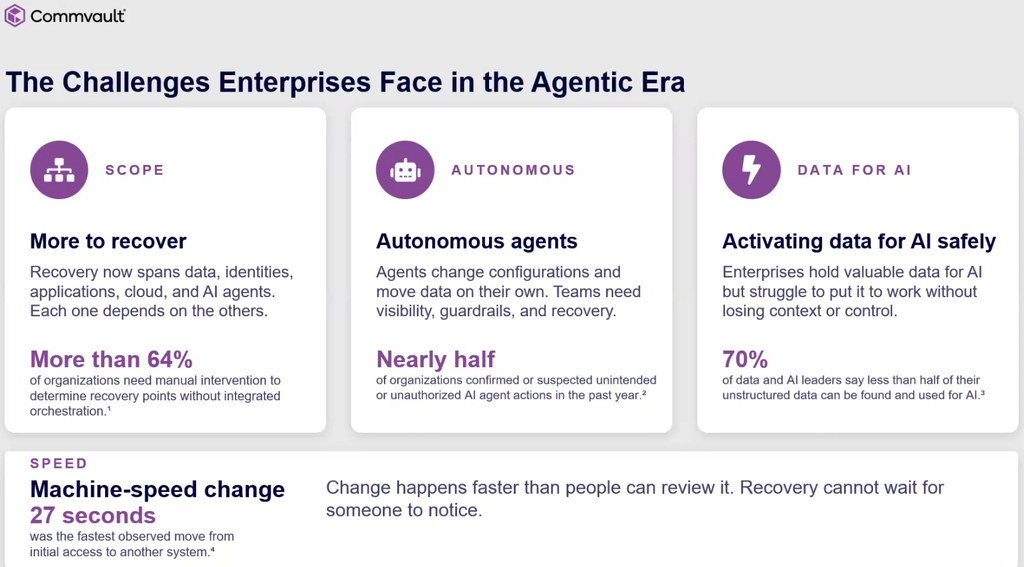
If you run VMware or hybrid infrastructure, Recovery Studio is the Commvault SHIFT 2026 announcement to watch. It uses runbooks to restore a whole business service in dependency order, identities and configurations included. Commvault announced it in Nashville on 10 November, alongside AgentRecover support for agents built on Microsoft Foundry and Amazon Bedrock AgentCore, Data Activate integrations with Databricks and NVIDIA, and a partnership with Zscaler.
None of it is generally available yet, and most of it reaches early access in November or December 2026. This post covers what each announcement does and when you can get it. It's based on Commvault's announcements and the press coverage rather than hands-on testing.
What Commvault announced at SHIFT 2026
| Announcement | What it does | Target dates |
|---|---|---|
| Recovery Studio | Runbook-driven recovery of applications, identities, configurations, infrastructure and data, in order | Early access December 2026. GA "in the coming months" |
| AgentRecover for Microsoft Foundry | Discovers and audits agents, then recovers the agent and the resources it changed | Early access November 2026 |
| AgentRecover for Amazon Bedrock AgentCore | As above | Early access December 2026 |
| Data Activate for Databricks | Shares Commvault-protected data into Databricks as governed tables | Early access December 2026, select Azure regions |
| NVIDIA reference design | Makes protected data searchable for AI applications and agents | Early release December 2026. GA in 2027 |
| Zscaler partnership | AI discovery and policy from Zscaler, recovery from Commvault | No product or date announced |
Recovery Studio
In a big recovery, restoring the VMs, databases and files is only the start. You then rebuild identities, firewall rules, cloud configurations and application dependencies by hand, because a lot of that sits outside the backup tool. Commvault puts the average time to get back to a minimal level of operation at 28 days with conventional methods, based on its own research.
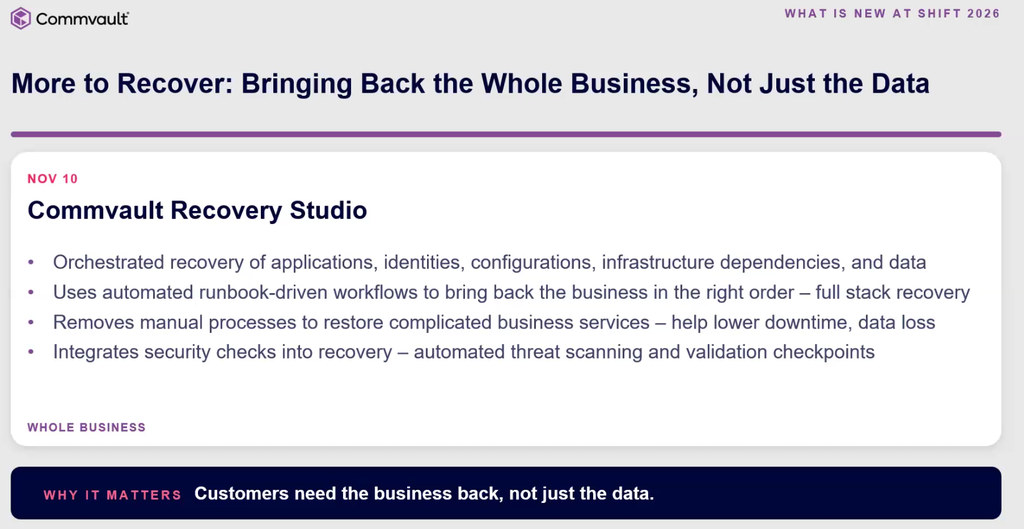
Recovery Studio puts that work into runbooks. Each runbook restores and validates the parts of a business service in order:
- applications, including containers, VMs, files and objects
- identity systems
- application and infrastructure configurations
- security and network settings, such as firewall rules and network security groups
- the data itself
The same runbooks cover operational, disaster and cyber recovery, and they can recover in place, out of place or into a cleanroom. You can add threat scans on supported resources and validation checkpoints, so anything compromised is flagged before it goes back into production.
The steps are defined in advance. Recovery Studio doesn't use AI to decide how to restore things, which suits me fine. The last thing you need mid-incident is a model improvising the restore order.
It builds on technology from Commvault's 2024 acquisition of Appranix (now part of Cloud Rewind) and the existing runbook approach. Prior work on Cleanroom or Active Directory recovery should be relevant, even if the exact import path isn't fully detailed yet.
Early access is targeted for December 2026, with general availability planned "in the coming months". Pricing is based on the amount of data you configure for orchestrated recovery.
Identities come first
Runbooks restore trusted identity services before the applications and users that depend on them reconnect. If your vCenter Server uses Active Directory as an identity source, that order affects you directly. Nobody signs in to vCenter with a domain account until AD is back, and you want that AD checked and clean before they do.
What it doesn't replace
You still need clean, tested backups and an accurate map of what depends on what. One analyst quoted by Network World made the point that automation only runs an out-of-date plan faster, and I agree. If you get into early access, build your runbooks and test them in a cleanroom before you rely on one in a real incident.
AgentRecover for Microsoft Foundry and Amazon Bedrock AgentCore
AgentRecover isn't new, but SHIFT extended it to agents built on Microsoft Foundry and Amazon Bedrock AgentCore. It's aimed at a problem a backup schedule doesn't handle well. An agent can change data, applications and infrastructure across several platforms faster than anyone can review what it did.
For a supported agent, AgentRecover:
- discovers the agent and maps the data, applications, tools, identities, configurations and infrastructure it works with
- records what the agent did and which resources it affected
- uses that record to work out what needs recovering, then restores the agent and the affected resources to a trusted point
You can also use it with Commvault's identity recovery and change auditing to see which identities the agent acted through.
Commvault's own AgentRecover blog post includes two caveats worth knowing before you plan around it:
- It isn't a selective undo. Commvault says it doesn't reverse only the agent's changes. You restore the affected components, or the wider AI system, to a trusted point. I'd plan on anything else that changed on those resources since then being rolled back too.
- Discovery doesn't add protection. If AgentRecover finds a resource that isn't protected, it shows you the gap. It doesn't close it for you.
Early access for Foundry is targeted for November 2026, and for Bedrock AgentCore for December 2026.
Once agents are in production, I think rolling back one bad agent action could become a more common job than recovering from a full disaster. Broadcom has its own agent Fling for VCF labs now, and I covered what it can and can't change on NSX in VCF Agentic AI Hub 0.2.0: what it does and how to set it up.
Data Activate with Databricks and NVIDIA
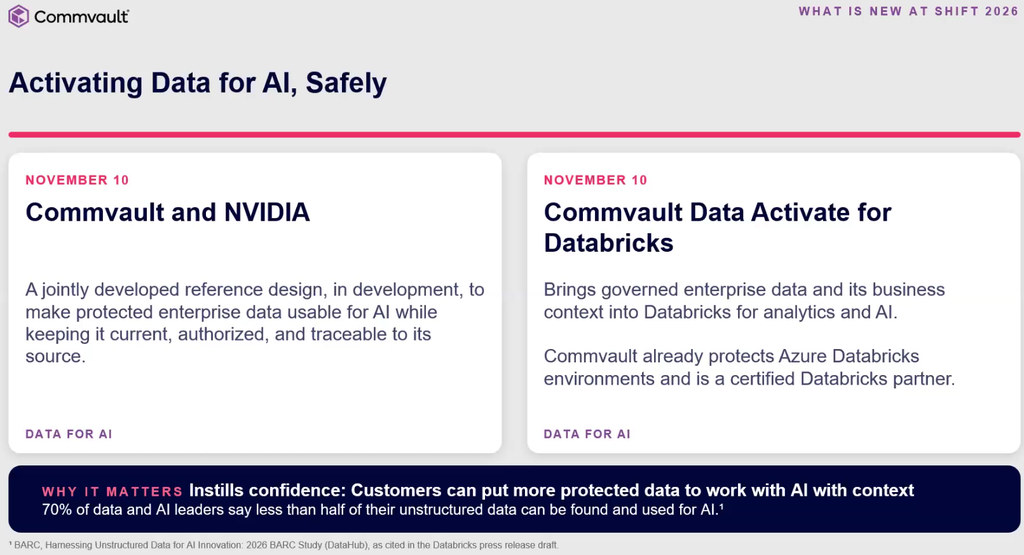
Data Activate makes data you already protect with Commvault available for analytics and AI, with its governance and permissions intact. SHIFT added two integrations.
Databricks
Data Activate for Databricks shares Commvault-managed data into Databricks through OpenSharing, as governed tables you manage in Unity Catalog. Ownership, access permissions and lineage carry over, and changes and deletions at the source flow through automatically. You don't need a separate connection to each original source.
Early access is planned for December 2026 in select Azure regions.
NVIDIA
The NVIDIA collaboration is a reference design rather than a product. It combines Data Activate with NVIDIA NIM microservices, Nemotron Retriever, and cuVS with Apache Solr, so applications and agents can find and retrieve Commvault-protected content. Data Activate keeps that content current as files change, retention periods expire or permissions are revoked.
Early release is due in December 2026, with general availability in 2027.
The Zscaler partnership
Commvault and Zscaler announced a strategic partnership on AI security. Zscaler's Security for AI products identify which AI applications, models and tools are in use, including unsanctioned ones, and enforce policy on what users and agents can do. Commvault adds recovery of data, applications and identities after a security incident or a bad agent action. The areas they've named so far are AI discovery, runtime governance, and agent detection and recovery.
There's no availability date just yet.
Watch Commvault SHIFT Virtual on 18 November
SHIFT Virtual is free, but you need to register. It runs live on 18 November in four regional slots:
| Region | Live broadcast |
|---|---|
| AMER | 13:00 ET |
| EMEA | 09:00 GMT |
| India | 14:30 IST |
| APAC | 12:00 AEDT |
Everything is available on demand from 19 November. There's a keynote from CEO Sanjay Mirchandani, six tracks including Identity Resilience and Simplify Hybrid Complexity, five-minute Lightning Lab demos and live Q&A during the broadcast. Register for free at commvault.com/shift-virtual. The virtual event starts November 18th 2026.
Resources
- Commvault Recovery Studio announcement (Commvault, 10 November 2026)
- Commvault AgentRecover blog post (updated 10 November 2026)
- Commvault strategic partnership with Zscaler (Commvault)
- Commvault and NVIDIA collaboration (Commvault investor relations)
- SHIFT Virtual registration
- Commvault unveils Recovery Studio, AgentRecover update and joint work with three partners (SiliconANGLE)
- Recovery Studio targets full-stack business restoration (Virtualization Review)
- Commvault expands AgentRecover to restore AI agents and affected systems (Virtualization Review)
- Commvault taps Databricks and NVIDIA to put backup data to work for AI (Virtualization Review)
- Commvault rolls out an automated recovery mechanism (Network World)
Feedback
If you found this guide useful, subscribe to the mailing list or follow me on X and YouTube.
Questions? Email me (contact@virtualg.uk) or DM me on X (@virtualg_uk).